Manage integrations in Settings
The Integrations section in Settings centralizes all services and authentication credentials connected to Olares. You can perform two main types of operations here:
- Connect services – Link cloud storage services such as Olares Space, AWS S3, and Tencent Cloud COS to extend Olares’ storage capabilities.
- Manage cookies – Store, import, and delete website cookies to support Olares’ access to subscription-based or restricted content.
- Manage SMB accounts – Store and manage usernames and passwords for SMB network shares, making it easier to reference them when mounting SMB shares in Files.
View and manage connected services
Follow these steps to view or manage your integrations:
- Open Settings from the Dock or Launcher.
- From the left sidebar, select Integrations > Link your accounts and data.
- Manage the existing integrations:
- View the list of authorized services and click a card to check its status or manage settings.
- On the Account settings page, click Delete to remove an integration.
Add cloud object storage via API keys
Olares supports manual configuration of AWS S3 and Tencent Cloud COS using API credentials:
- Navigate to Settings > Integration and click the + Add Account button in the top-right corner.
- Select AWS S3 or Tencent COS, then click Confirm.
- In the mount dialog box, fill in the required details:
- Access Key
- Secret Key
- Region
- Bucket name
- Click Next. You will see a success message if the credentials are valid.
Your connected cloud storage will now appear under the Cloud storage section in Files.
Alternatively, you can configure this direction directly within LarePass.
Integrations that require LarePass
OAuth-based integrations and Olares Space connections must be completed through the LarePass app.
See the LarePass integrations guide for details.
Manage Cookies
Manage cookies under Settings > Integrations > Cookie Management.
The Cookie Management page displays all saved cookies, grouped by domain.
Each entry shows the cookie name, value, expiration date, and associated domain.
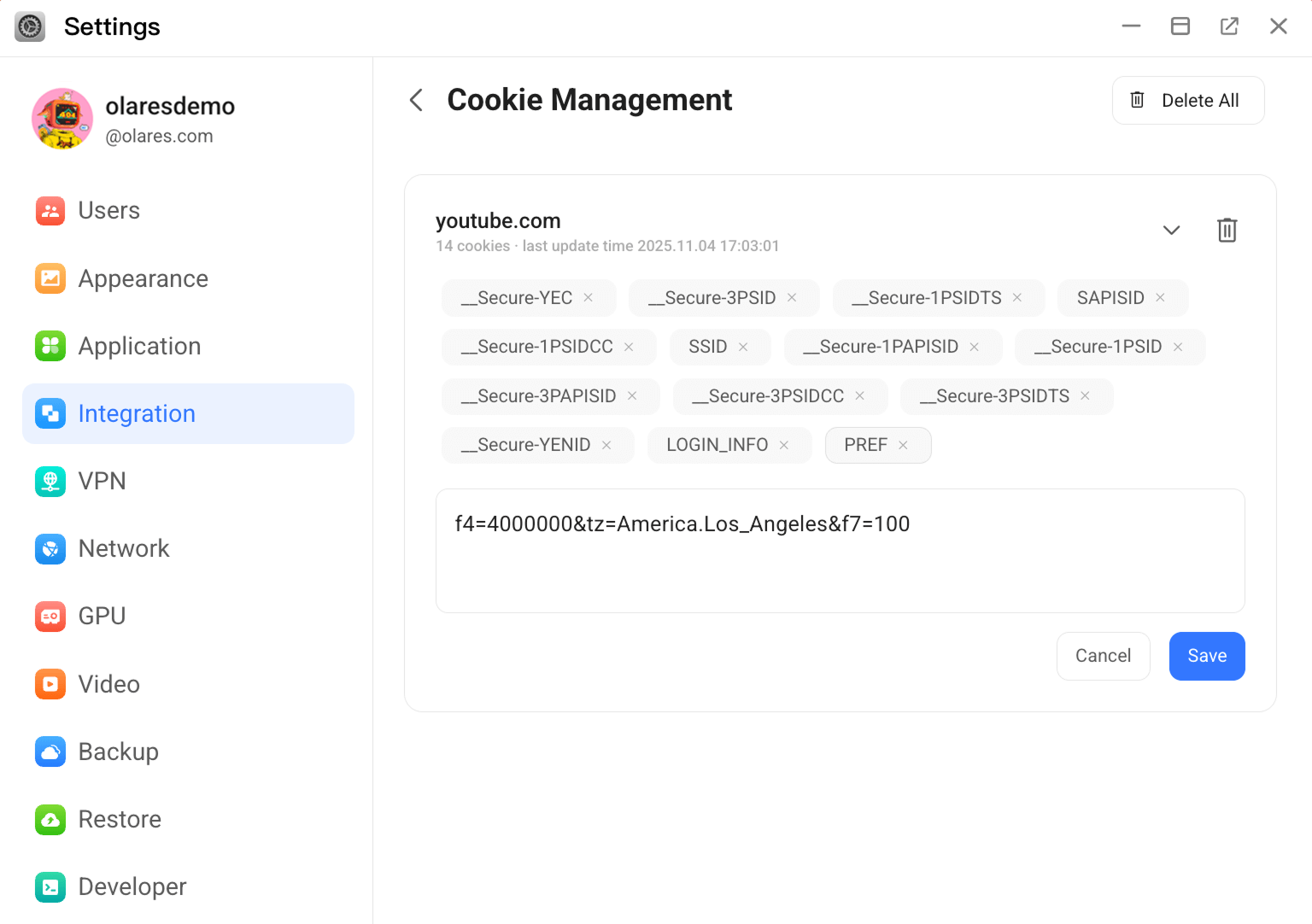
You can perform the following actions:
- Upload cookie – Paste cookie content into the import dialog. Supported formats include Netscape, JSON, and Header String.
- Edit cookie – Click a specific cookie entry to modify its value in the editor below.
- Delete cookie – Remove invalid or expired cookies. You can delete cookies individually or in bulk.
Keep cookies up to date
When a cookie expires, the system will highlight it in red.
Expired or missing cookies may cause some subscription or web automation tasks to fail. It’s recommended to check and update cookies periodically.
Manage SMB accounts
SMB account management allows you to centrally store usernames and passwords for accessing SMB network shares. You can view, add, or delete accounts here for easy reference when mounting SMB shares in Files.
To view SMB accounts, go to Settings > Integration > SMB account management. All saved SMB accounts are listed.
To add an SMB account:
a. In SMB account management, click Add account.
b. In the Add account window, enter the username and password required to access the SMB share.
c. Click Confirm. The information is saved and displayed as a new record in the SMB account list.
To delete an account, click delete on the right of the account record, and then click Confirm. The account and its credentials are removed.
Use SMB accounts to mount shares
- SMB credentials are stored locally and are not uploaded to the cloud. It is recommended to periodically check and update saved credentials to keep them in sync with the server.
- Saved SMB accounts do not automatically mount shared folders, and you cannot select them directly in Files. To mount an SMB share, manually enter the server address along with the username and password saved here in Files. For more information, see Mount SMB shares.