Access Olares services securely
Typically, you access Olares services through a browser using a URL like https://desktop.<username>.olares.com. This way, you can reach your services from any device at any time. You can access Olares securely from your home network or from elsewhere.
- Using LarePass VPN: Use this whether you are on your home network or away.
- Using the .local domain: Use this only when your client device and Olares are on the same LAN.
Using LarePass VPN
It is recommended to enable the LarePass VPN to ensure your connection is always secure and efficient. The client automatically detects your network environment and selects the best connection method:
- At home: It establishes a direct Intranet connection to allow faster file transfers on your local network.
- From remote: It switches to a secure encrypted tunnel so you remain connected safely when accessing remotely.
Always enable VPN for remote access
Keep LarePass VPN enabled. It automatically prioritizes the fastest available route to ensure you always get the best speed possible without manual switching.
iOS and macOS setup
On iOS or macOS, you may be prompted to add a VPN Configuration to your system settings the first time you enable the feature. Allow this to complete the setup.
Enable the LarePass VPN directly on the device you are currently using to access Olares.
Once enabled, check the status indicator in LarePass to verify the connection type:
| Status | Description |
|---|---|
| Intranet | Direct connection via your local LAN IP. Fastest speeds. |
| P2P | Direct encrypted tunnel between devices. High speed. |
| DERP | Routed via a secure relay server. Used as a fallback. |
Using the .local domain
Use the .local domain when your device and Olares are on the same LAN.
URL format
When your device is on the same local network as Olares, you can use a .local domain to reach your services so traffic stays on your LAN.
Use a multi-level .local hostname that mirrors your standard URL. This format works with Olares system apps and community apps.
TIP
Use http://, not https://, with the .local URL.
Standard URL
https://<entrance_id>.<username>.olares.comLocal URL
http://<entrance_id>.<username>.olares.localmacOS
No setup is needed. Use the local URL in your browser (for example, http://desktop.<username>.olares.local).
Windows
On Windows, .local hostnames are not resolved by default. Use the LarePass desktop app to add the necessary entries to your hosts file so multi-level .local URLs resolve to your Olares device.
Open the LarePass app, click your avatar, then Settings.
Scroll to Enable local service domain and click Add. LarePass will update your hosts file automatically.
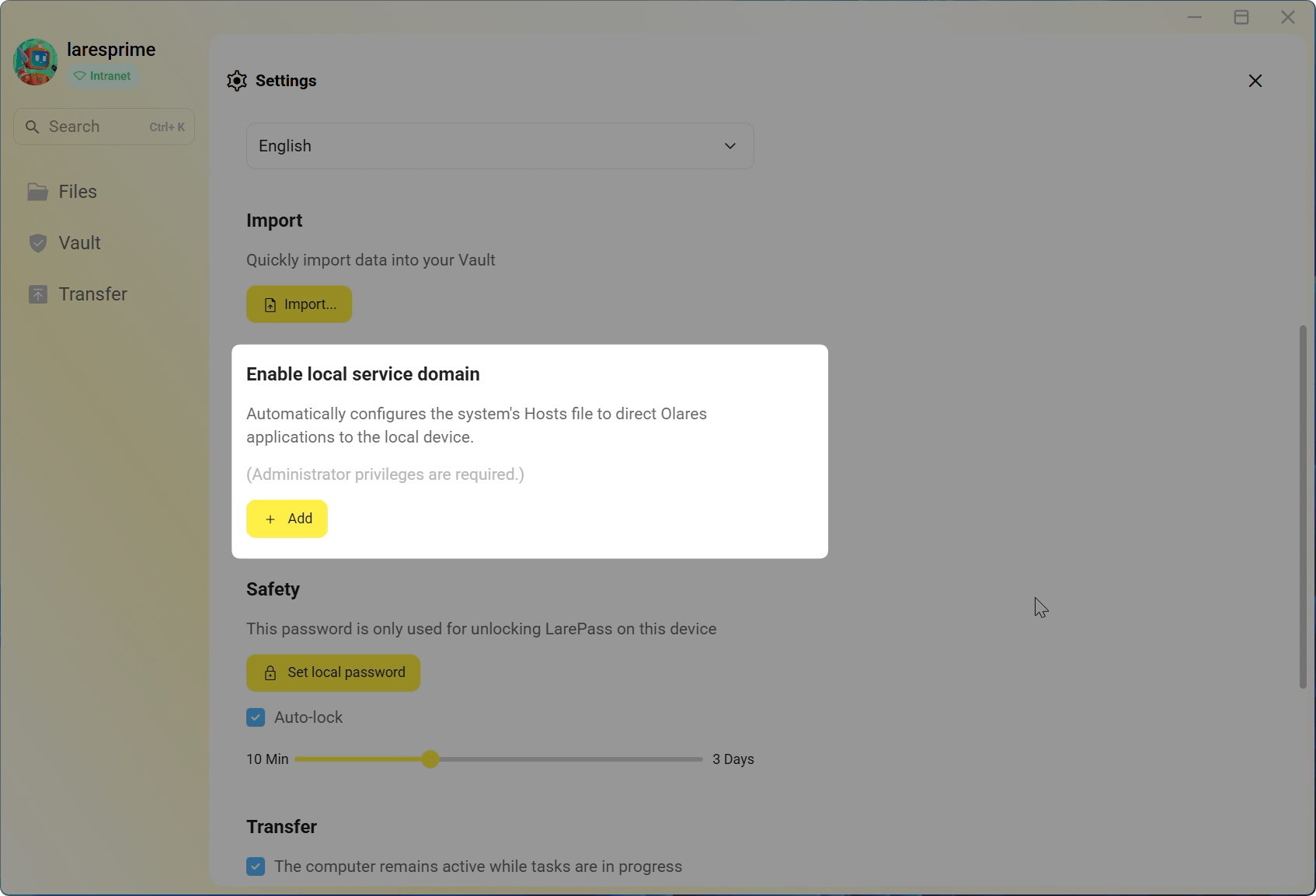
When the update completes, a success message appears. If a command line window opens, you can close it.
(Optional) To verify the changes to the hosts file:
a. Go to
C:\Windows\System32\drivers\etc\.b. Open the
hostsfile in a text editor. You should see the.localentries that LarePass added.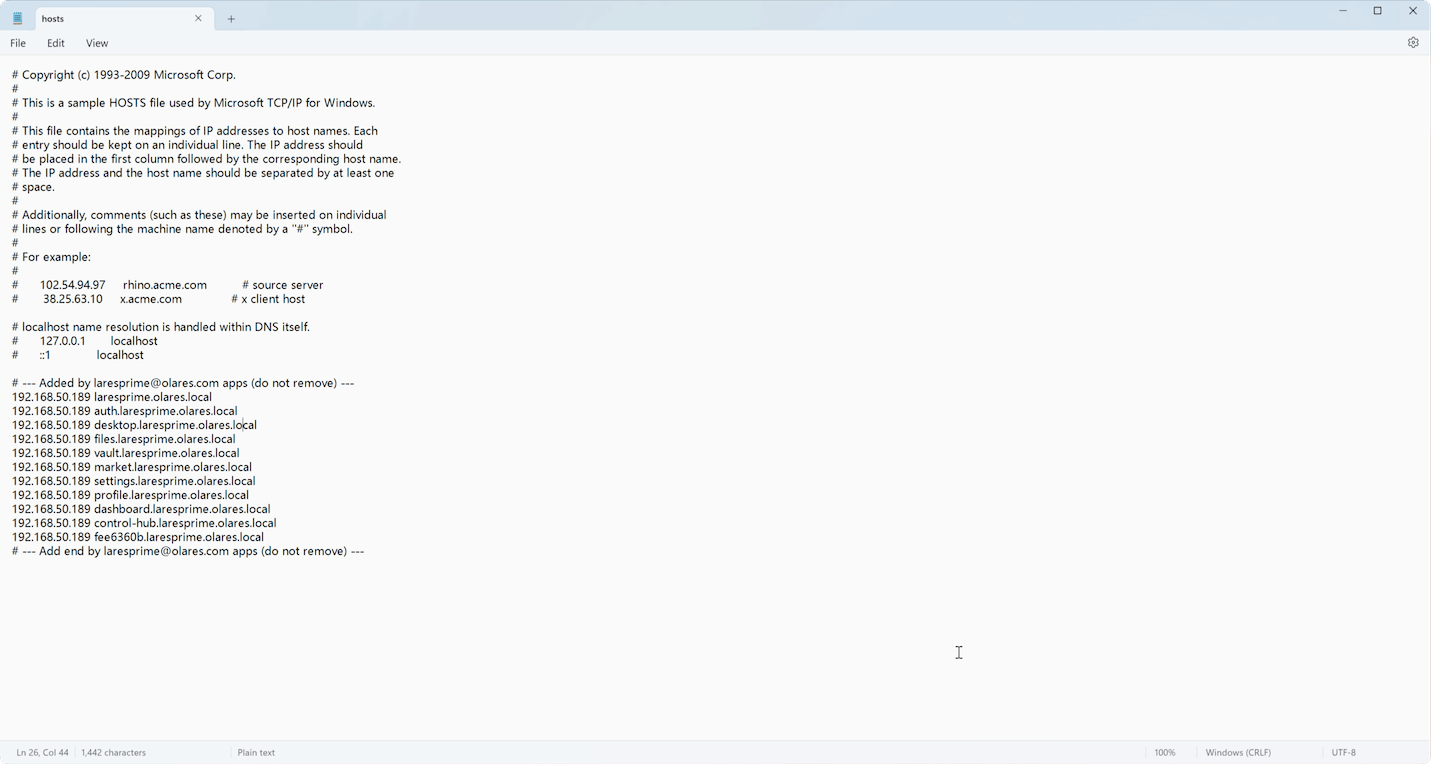
FAQs
Why doesn't LarePass VPN work on my Mac anymore?
macOS blocks the VPN tunnel if the network extension or VPN configuration was not fully set up, or if the extension has become stuck or corrupted. See LarePass VPN not working to reset the extension and restore the VPN.
Why can't I enable LarePass VPN on Windows?
Third-party antivirus or security software may mistakenly flag LarePass as suspicious, preventing the VPN service from starting. See LarePass VPN not working to resolve the issue.
Why doesn't the .local domain work in Chrome on macOS?
Chrome may block local URLs if macOS has not granted it local network access.
- Open the Apple menu and go to System Settings.
- Go to Privacy & Security > Local Network.
- Find Google Chrome and Google Chrome Helper and turn their toggles on.
- Restart Chrome and try the
.localURL again.

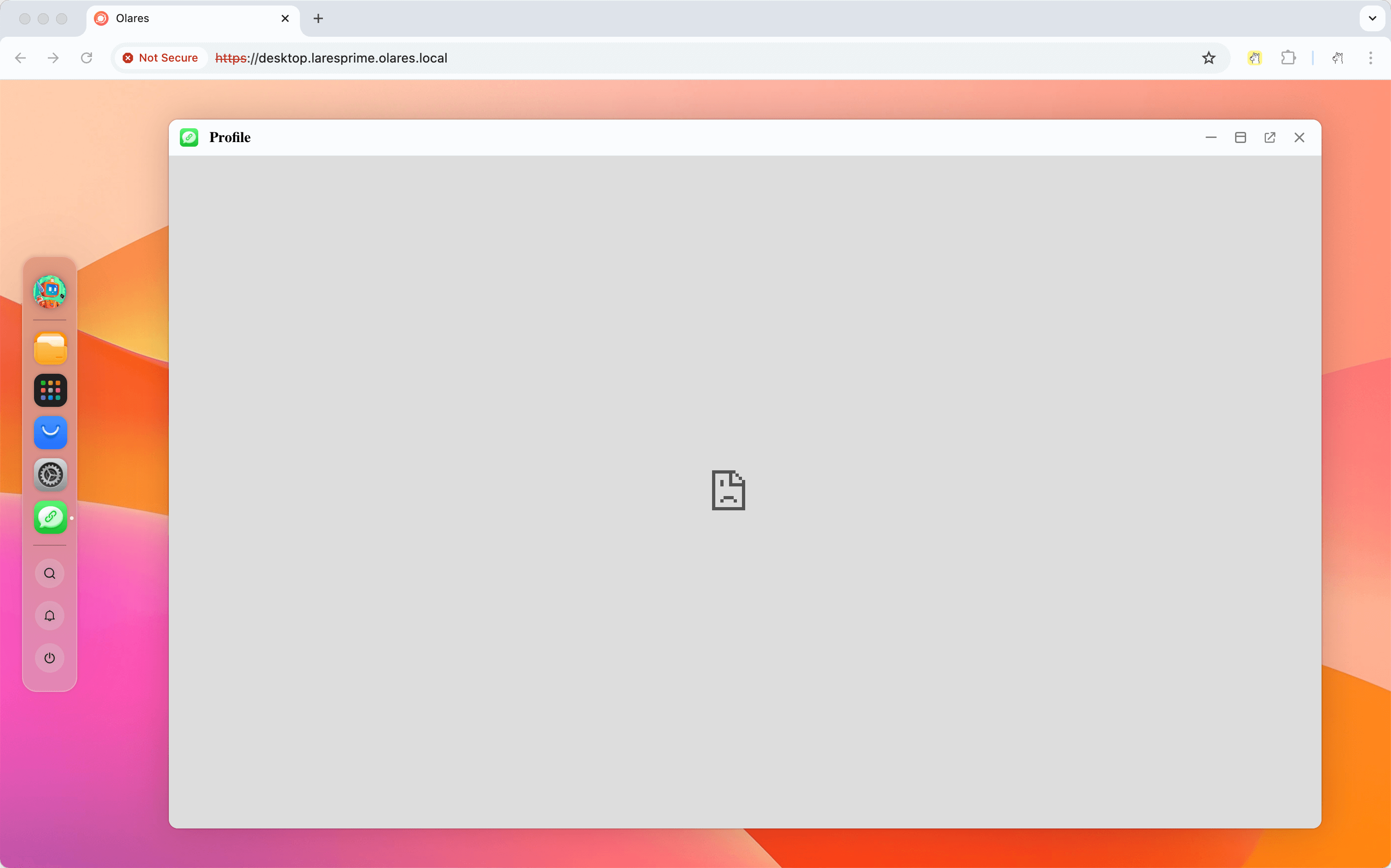
Why does the app show "connection not secure" or fail to load in Chrome?
Chrome sometimes forces HTTPS for .local hostnames, which is not supported.
Use http:// explicitly at the start of the URL (e.g. http://desktop.<username>.olares.local). On your home network, this unencrypted local connection is expected and keeps the .local domain working.
Why does the iframe flicker when I open a .local URL in Safari?
Safari applies stricter handling to .local (and other non-HTTPS) content in iframes, which can make the iframe flicker or reload. Enabling two options in Privacy settings fixes it.
To fix it:
Open Safari and go to Settings.
Open the Privacy tab.
Enable the two options:
- Prevent cross-site tracking
- Hide IP address from trackers

Reload the
.localpage.
Learn more
- Access Olares locally: Explore detailed instructions for all available local network connection methods.
- Network: Learn about the different entry points in Olares.